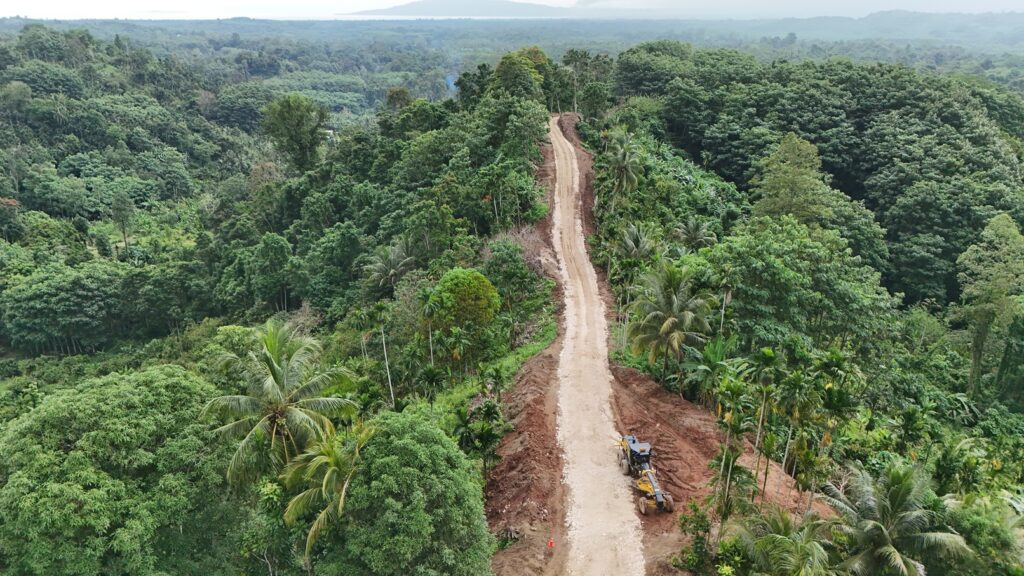
Inland Baining, Gazelle, East New Britain, 7 June 2025 – For decades, the people of Sandaun Block — a remote agricultural community in Inland Baining where settlers from all over Papua New Guinea have bought land and built new lives — have lived with isolation, hardship, and determination. But now, under the Papua New Guinea Agriculture Commercialization and Diversification (PACD) Project, supported by the PNG Government and the World Bank, change has finally arrived in the form of a 3.5-kilometre feeder road linking Vunapalading and Burit in the mountains.
The K4.1 million project, launched on 22 April 2025 and scheduled for completion by 20 December 2025, is not only restoring access but restoring hope — with community members saying the road is a symbol of long-awaited inclusion and recognition.
“This Is No Ordinary Road”
Raymond Paulias, Senior Engineer with PACD, described the project as more than just a construction job.
“This road is more than gravel and culverts — it is an economic lifeline,” he said. “It means market access for cocoa farmers, school access for children, and health access for families. Already, labour has been sourced locally, so benefits are immediate. We’re also training communities to maintain the road after completion so the impact continues well beyond the project.”
Paulias said the road would reduce travel time, vehicle operating costs, and improve economic output.
“Improved road conditions always open up rural economies. Cocoa output will increase. Materials will move faster. Health and education services will reach people sooner. It’s transformational.”
“Four Hours on Foot, Now 10 Minutes by Car”
Contractor Gary Gan, Manager of COVEC PNG Ltd, shared his personal experience of visiting the site for the first time“I thought it was a small, unimportant road — until I walked it,” he said. “Four hours on foot, heavy jungle and mud. But now, just 10 minutes by vehicle. This isn’t just a road. It’s a connection to life, trade, and dignity. Farmers used to carry cocoa bags by hand; now they can drive. This road connects people to the outside world. It is an honour for me to build it.”
Youth: “We Were the Third Generation Still Waiting”
Michaelyne Nurvue, the Youth Representative for Sandaun Block, spoke emotionally about growing up in hardship and watching her parents — the second generation of settlers — struggle to send their children to school through cocoa earnings.
“We are the third generation. Our parents were cocoa farmers who paid our school fees from sweat and mud. We used to walk 3 to 4 kilometres to reach the main road in rain and mud just to carry cocoa,” she said. “This road has finally arrived after all these years. It means everything to us.”
Students: “We Were Always Late, Always Wet”
Coneyberth Kamuk, representing the student voice, echoed the experience of long daily walks to school.
“We used to arrive late, soaked from the rain. Sometimes we had to miss school completely. This road is our answer,” he said. “Now, younger students won’t have to suffer the way we did.”
Lead Farmer: “From Seedlings to Market Access”
Steven Liai, a cocoa farmer who has worked the land since 2012, described the history of agricultural efforts in the area, from the earlier PPAP project to now PACD.
“We planted thousands of seedlings — 720 per farmer across 280 farmers. But there was no road. We waited for years while our cocoa ripened with no access to market,” he said. “Now PACD has brought the road. I want to thank the contractor, COVEC, and the team — this is what real change looks like.”
Pastor: “We Worked with Bare Hands and Firewood”
Pastor Henry Edward shared a generational perspective, remembering the days when everything — from farming to cooking — was done manually.
“We had no machines, no roads. Just bare hands and firewood,” he said. “We cleared bush, built homes, raised families — all by hand. Now that the road is here, we finally feel that we are being seen. This is an answered prayer.”
Women’s Voice: “40 Years of Struggle Is Ending”
Jennifer Nurvue, a women’s leader in the community, reflected on decades of waiting.
“We’ve lived here 40 years. The road was always promised, never delivered. In 2012 we joined the cocoa rehabilitation efforts — still, the road didn’t come,” she said. “But today we see it being built, and it relieves so much pain. We thank everyone — this is for our daughters and granddaughters too.”
Community Elder: “25 Years Waiting”
Joseph Tovungia, who moved to Sandaun Block in 2001 and planted 2,500 cocoa trees, summed up what the road means for those who made a life on untouched land.
“We’ve carried cocoa bags on our backs for decades, down steep hills and muddy tracks. Our children were born here, raised here. Now, finally, we have a road,” he said. “Thank you to the World Bank, the Government, and COVEC. You have made our lives easier and brought services closer.”
As Papua New Guinea celebrates 50 years of Independence, the story of Sandaun Block and its new feeder road is a poignant reminder of what inclusive, grassroots development means: bringing opportunity where there was only struggle, and delivering progress not to the privileged, but to the patient, persistent, and proud rural people of PNG.
###