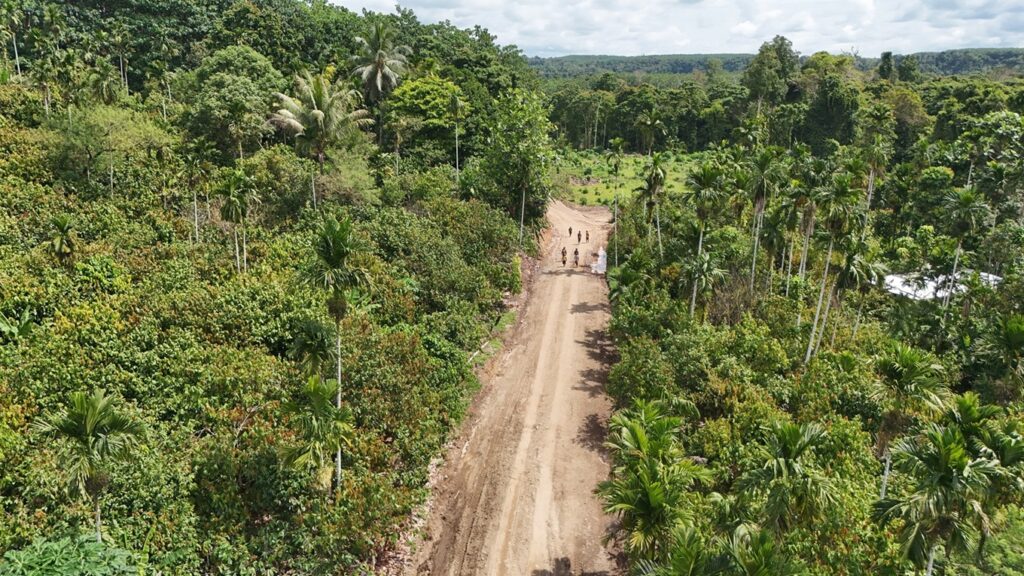
KULUNGURE, SINIVIT LLG, POMIO DISTRICT – Saturday, 7 June 2025: The rehabilitation of the Kulungure Feeder Road in Sinivit LLG, Pomio District, East New Britain Province, is making steady progress under the Papua New Guinea Agriculture Commercialisation and Diversification (PACD) Project, a national initiative funded by the Government of Papua New Guinea with support from the World Bank.
PACD Senior Engineer Raymond Paulias said construction began at the end of May 2025 and is currently 35 percent complete. The project is valued at K5.6 million, an increase from the original contract price of K4.9 million due to procurement delays and adjustments in scope, including additional protective works.
“Clearing and grubbing have been completed, and we are now preparing for the installation of culverts and drainage structures,” Mr Paulias said. “This area is prone to flooding, so river training works have been added to protect both the road and surrounding cocoa farms.”
The road is part of Component 2 of the PACD Project, which focuses on improving rural infrastructure to support agricultural productivity. Mr Paulias said Kulungure was selected based on a cost-benefit analysis due to its status as one of the highest cocoa-producing zones in the Gazelle Peninsula.
“Increasing market access is critical for our rural farmers,” he said. “Transport constraints have long affected production volumes and income. This project directly addresses that.”
The PACD Project includes three road projects: one in each region and another in the Autonomous Region of Bougainville, all of which are expected to be completed before the PACD’s conclusion at the end of December 2025.
Local Leaders Speak Out
Local leaders have welcomed the project as a long-overdue development for their communities, highlighting its potential to transform not only the cocoa industry but also access to essential services.
Ward Development Committee Chairman for Infrastructure, Mr Russel Anip, said the road was a long-standing need.
“We’ve waited more than ten years for this,” he said. “Many families have struggled to access health services, schools, and markets. This development will benefit everyone — not just cocoa farmers.”
Women’s Representative Mary Madao said the road would significantly ease the burdens on women, who often walk long distances to access basic services and markets.
“Our mothers have carried heavy loads of cocoa and struggled to take their children to clinics and schools,” she said. “This road will change our lives by making transport safer and faster.”
Youth Chairman Clive Niali highlighted the challenges faced by young people in the area due to poor infrastructure.
“In the wet season, we often had to wade through rivers and walk for hours to transport cocoa or access supplies,” he said. “This road brings real opportunities for youth to engage in farming and business.”
Community leader Benny Kania said the project should be followed by further infrastructure and service investments, particularly in electricity and agro-processing.
“Now that the road is coming, we are looking to the future. We want to process cocoa here, not just sell raw beans,” he said. “We hope the government and its partners can support us with electricity and facilities for value addition.”
Mr Kania said the community is already planning to expand cocoa blocks and engage more youth in cultivation, adding that landowner interest in farming is growing again thanks to improved accessibility.
Community Involvement and Ownership
Mr Paulias said the project includes a strong community engagement component, with training planned to support basic road maintenance after construction.
“We are working closely with the community to ensure long-term sustainability,” he said. “Ownership is key. Once the road is built, the people must take pride in maintaining it — clearing drains, cutting grass, and keeping it in good condition.”
The road will not only reduce travel times and transport costs but also facilitate faster movement of goods and services, making it easier for residents to reach hospitals, schools, and markets.
About the PACD Project
The Papua New Guinea Agriculture Commercialisation and Diversification (PACD) Project aims to enhance the productivity and market access of smallholder farmers in selected value chains, including cocoa, coffee, oil palm, rubber, spices, and livestock. It focuses on supporting rural infrastructure, strengthening farmer groups, and encouraging public-private partnerships.
The Kulungure Feeder Road is among several feeder road upgrades currently underway across Papua New Guinea under PACD’s rural infrastructure component. The project is jointly managed by the Department of Agriculture and Livestock and the World Bank.
With Papua New Guinea marking its 50th year of Independence in 2025, projects like the Kulungure Feeder Road are being seen as key indicators of the government’s commitment to inclusive rural development and economic diversification.
The road is expected to be completed by December 31, 2025, aligning with the official closure of the PACD Project.